
Three frontier labs picked their hill on the same Tuesday.
PickBits Daily Signal · Tuesday, April 28, 2026

// tl;dr
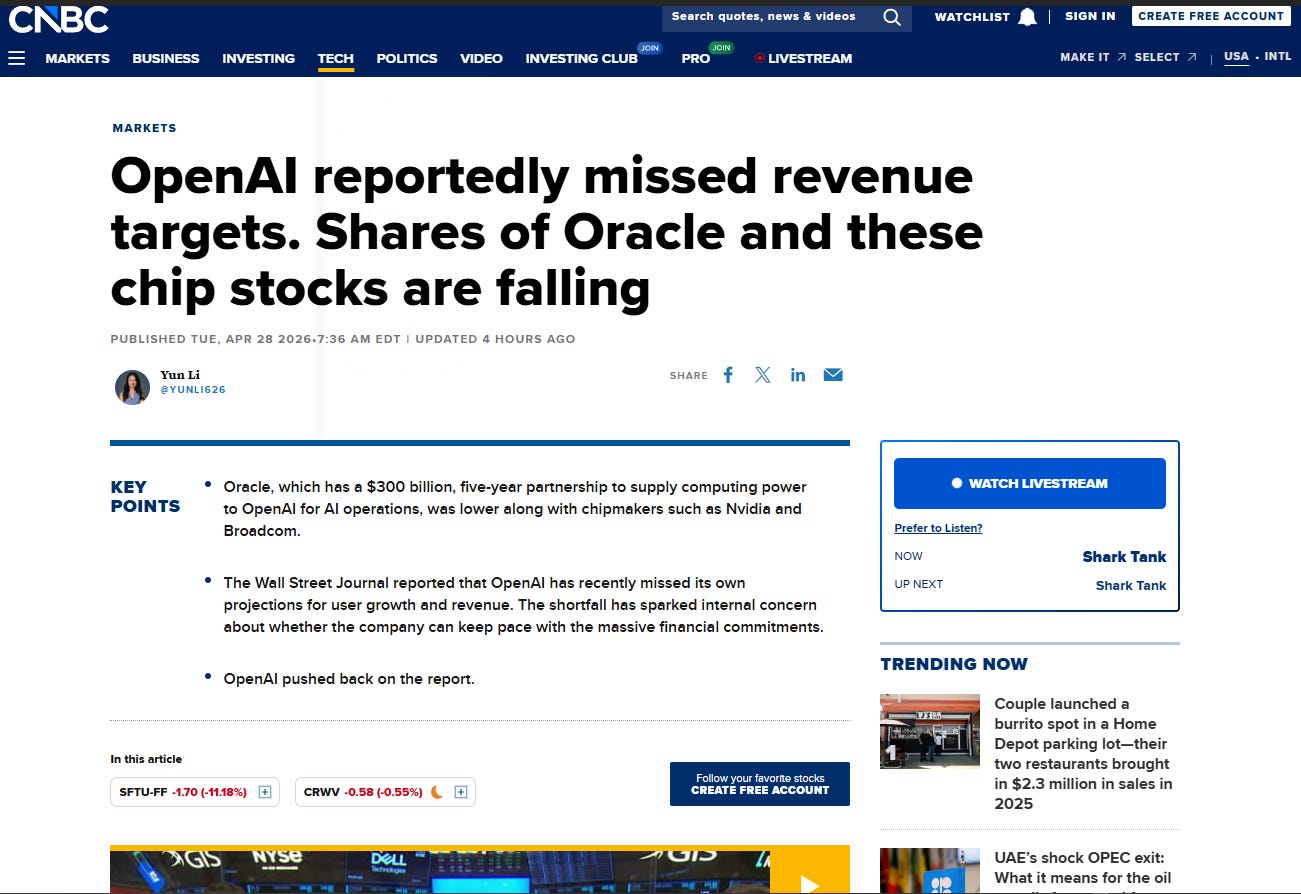
OpenAI missed internal revenue and user targets. Oracle fell 5%, SoftBank fell 11% premarket on the report. The 1B weekly active user goal slipped past the end of 2025; CFO Sarah Friar warned internally that future compute contracts are at risk. ChatGPT’s web traffic share fell from 86.7% to 64.5% YoY, while Gemini climbed from 5.7% to 21.5%.
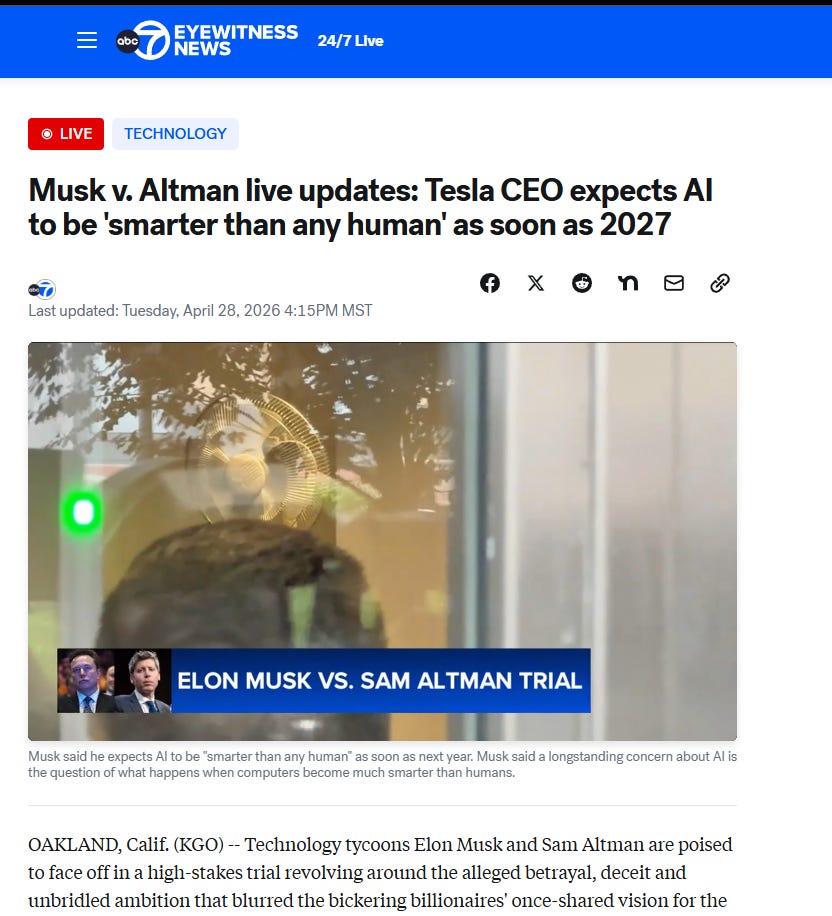
Musk v. Altman jury seated in Oakland. Nine Bay Area jurors picked Monday; opening arguments Tuesday; three weeks of testimony expected. The case turns on the 2015 founding documents and whether OpenAI’s pivot to profit was a breach of the original mission. Whatever the jury decides constrains every AI lab with charitable origins.
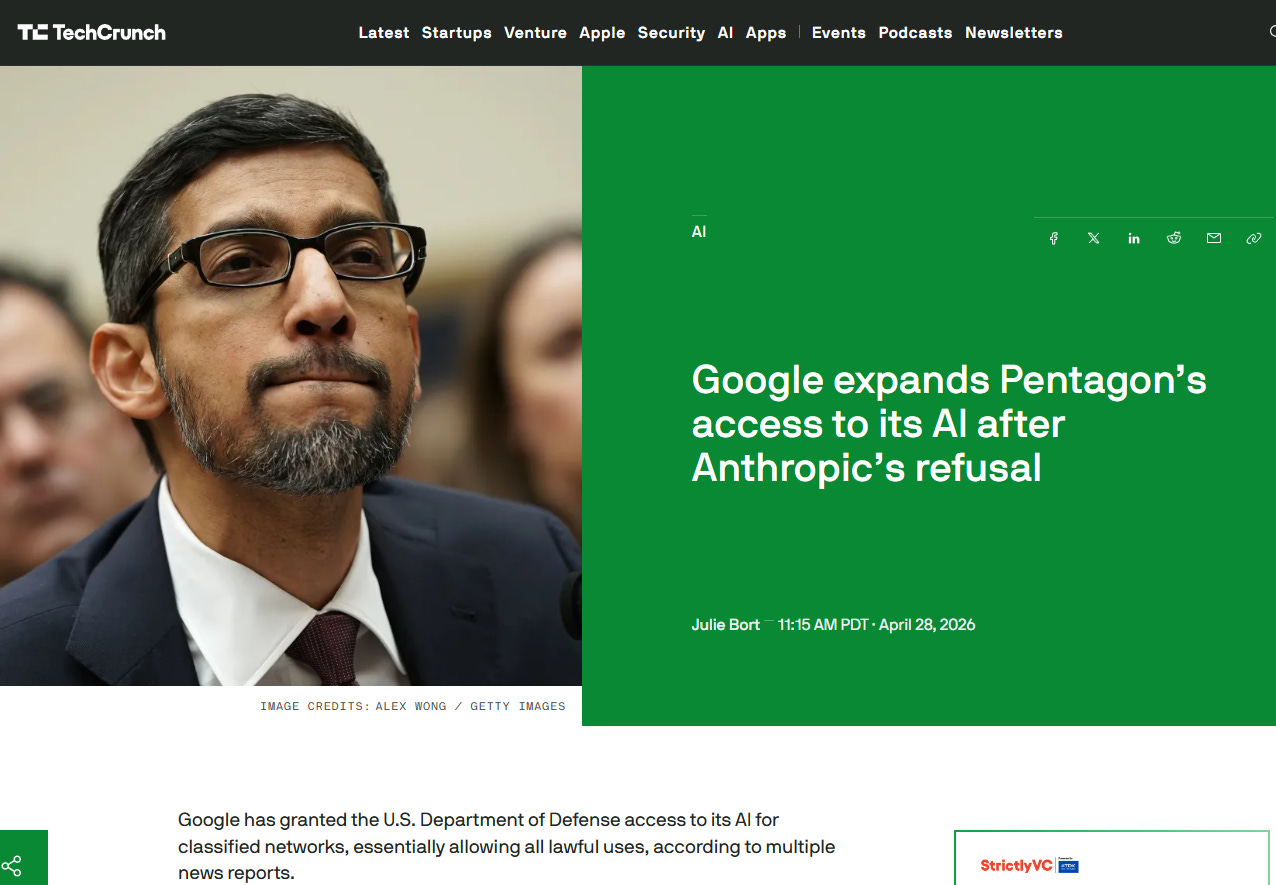
Google signed a classified Pentagon AI deal over a 600-employee petition. Anthropic refused the same contract terms in February, and the Pentagon banned Anthropic on Feb 27 in response. Google proposed safety language (”no autonomous weapons, no domestic surveillance without humans in the loop”); the Pentagon downgraded it to “any lawful purpose.” Google quietly exited a $100M drone-swarm contest the same week.
Counter-signal: the Microsoft–OpenAI exclusivity unwind, the OpenAI phone leak, and Sam Altman’s “AI washing” admission all happened in the last 48 hours. They’re real, they matter, and they’re already yesterday’s story. The new story is which lab will say no to which contract — and which capital structure makes that choice possible.
Today, three of the four frontier AI labs moved simultaneously but in different directions. OpenAI got a margin call from its own ecosystem — internal revenue and user targets missed, Oracle and SoftBank trading down hard premarket. A federal jury was seated in Oakland federal court to decide whether OpenAI ever had the legal right to leave nonprofit status in the first place. And Google signed a classified Pentagon AI deal over a petition from more than 600 of its own employees — taking the same contract terms Anthropic refused in February, on the same week Google quietly exited a separate $100M Pentagon drone-swarm contest. Anthropic held the line. Google crossed it. OpenAI is taking the contracts in between. Three labs, three different lines drawn on the same day.
The frontier-lab tier is splitting along a single axis, which each company will refuse. The choice is no longer voluntary — it’s a function of revenue, capital structure, and how loud your engineers are willing to be.
1. The revenue miss — Oracle -5%, SoftBank -11%, the CFO warns that future compute contracts are at risk
OpenAI missed its internal goal of one billion weekly active users by end of 2025 and missed multiple monthly revenue targets through Q1. According to the report, CFO Sarah Friar warned internally that if growth doesn’t accelerate, future compute contracts — the ones underwriting Oracle’s $300B five-year cloud build-out and SoftBank’s 11–13% stake in OpenAI — are at risk.
The market read it instantly. Oracle dropped 5% premarket; SoftBank dropped 11%. The chip names exposed to OpenAI inference workloads followed. The $300B Oracle cloud deal sits at the center of Oracle’s growth story; that deal’s economics depend on OpenAI’s compute consumption ramping, as the contract assumes. The traffic data adds the why: ChatGPT’s share of LLM web traffic dropped from 86.7% a year ago to 64.5% today, while Google Gemini climbed from 5.7% to 21.5% in the same window. That isn’t a model-quality problem. That’s distribution, default integration, and Google paying nothing for the eyeballs ChatGPT has to acquire.
Why this matters: The dominant 2024–2025 thesis was that OpenAI had pricing power, and everything downstream of it was an annuity. The Oracle deal, the SoftBank stake, the Microsoft exclusivity — all of it priced as if OpenAI’s revenue trajectory was the certainty in the equation. The CFO's warning that compute contracts are at risk is the first time we have a record of the inside of OpenAI acknowledging the certainty has slack in it. Every Q2 enterprise AI procurement decision that has been deferred waiting for ChatGPT pricing to settle just got new information.
https://www.cnbc.com/2026/04/28/openai-reportedly-missed-revenue-targets-shares-of-oracle-and-these-chip-stocks-are-falling.html
2. Musk v. Altman — nine jurors seated in Oakland, three weeks of testimony, the 2015 documents in evidence
Nine Bay Area jurors were seated Monday in Oakland federal court. Opening arguments began on Tuesday. The trial is scheduled for three weeks. The case is a civil action turning on whether Musk’s 2015 contributions to OpenAI were predicated on the company remaining a nonprofit and whether the eventual restructuring breached that understanding. Musk wasn’t in court Monday, but he was on X, calling Sam Altman “Scam Altman” and Greg Brockman “Greg Stockman,” claiming he founded OpenAI “for the public good, not profit.”
The 2015 founding documents are entering evidence this week. That alone is a moment — the original term sheets, the early board minutes, the email exchanges between Musk, Altman, Brockman, and the founding team. The narrow legal question is whether OpenAI’s pivot to a capped-profit structure breached the original arrangement. The wider question, the one every AI lab founded with charitable or public-benefit framing is watching, is what guardrails a US federal jury places on the conversion from nonprofit to for-profit when the for-profit upside becomes large enough to matter.
Why this matters: Whatever the court rules on nonprofit-to-for-profit conversion constrains every AI lab with charitable origins — Anthropic’s PBC structure, the Allen Institute, the long-tail of academic-spinout labs. The 2015 documents themselves are likely to be the most consequential disclosure of the trial; whatever email or memo lands in evidence here becomes part of the historical record on how OpenAI was actually structured at its founding. The companies most exposed are not Anthropic or DeepMind; it’s the next generation of frontier labs forming under nonprofit shells right now, while the case is litigated.
https://abc7news.com/live-updates/elon-musk-sam-altman-live-updates-week-1-trial-could-alter-direction-artificial-intelligence/18968485/
3. Google signed the Pentagon AI deal Anthropic refused — over a petition from 600 of its own employees
The cleanest, freshest story of the day is the one that was quietly reported. Google signed a classified Pentagon AI deal Tuesday, giving the Department of Defense access to Gemini for classified networks. The deal closed despite a petition from more than 600 Google employees calling on CEO Sundar Pichai to reject “any contract that would allow our AI to be used in inhumane or extremely harmful ways,” with explicit reference to lethal autonomous weapons and mass surveillance.
The contract language is the story. Google reportedly proposed safety guardrails — no autonomous weapons targeting, no domestic mass surveillance without humans in the loop. The Pentagon’s preferred language: “any lawful purpose.” That language won. Compounding the signal, Google quietly withdrew from a separate $100M Pentagon drone-swarm contest the same week — the precise contract Anthropic also refused in February when the Trump administration banned Anthropic from federal use for declining the same terms. The takeaway: Google will sign for “any lawful purpose,” but won’t compete for the autonomous-targeting drone work outright. The line moves; it just moves differently at every lab.
And the enforcement mechanism is the part that the petition noticed. Once Gemini is running on air-gapped classified networks, Google cannot see which queries are issued, which outputs are produced, or which decisions are made. The “no autonomous weapons” language in the contract is only as strong as a Pentagon process Google has no visibility into. Anthropic’s CEO Dario Amodei called the same trade-off a “bright red line” he wouldn’t cross. Six months later, Sundar Pichai signed it.
Why this matters: Three frontier labs, three different positions on the same procurement question. Anthropic refused, lost the contract, and got banned by executive order — but kept the moat ($40B+ Google investment, $5B+ Amazon investment, principled brand among enterprise customers). Google signed, kept the revenue, and absorbed the employee revolt. OpenAI is taking the $200M Pentagon Pilot Contract that Anthropic walked away from. The labs are no longer differentiated only by capability or pricing — they’re differentiated by which contracts they’ll refuse. Procurement teams shopping for AI now have a governance dimension on the spec sheet, alongside latency and cost per token.
https://techcrunch.com/2026/04/28/google-expands-pentagons-access-to-its-ai-after-anthropics-refusal/
∆ The counter-signal — what’s continuing while the headlines burn
Three threads from the last 48 hours kept moving today, even though they didn’t lead. The Microsoft–OpenAI exclusivity unwind from Monday’s joint blog post is real — Azure exclusivity ended, the AGI clause was stripped out, the revenue share unwound in both directions, and ChatGPT is now cleared to run on AWS, Google Cloud, and Oracle Cloud. The first Fortune 500 to publicly route ChatGPT Enterprise traffic through a non-Azure cloud will tell us whether the new optionality is theoretical or material. Sam Altman’s “AI washing” quote is on the record, with confirmed AI-driven cuts running closer to 4.5% of the documented 92,000+ tech-layoff total YTD — the displacement headline number is inflated, the trend is still real, and the press cycle on AI-attributed RIFs gets harder from here. And the open-weight tier kept grinding: Gemma 4 sits at #3 on Arena under Apache 2.0; Qwen3.5-MoE-397B is close behind on AIME math; DeepSeek V4-Pro production deployments are still pulling Hub downloads at $ 0.145 and $3.48 per million tokens. None of those moved the headlines today because OpenAI and Google moved harder. All of them are still rewriting the cost math underneath every Q2 enterprise deployment plan.
https://blogs.microsoft.com/blog/2026/04/27/the-next-phase-of-the-microsoft-openai-partnership/
https://decrypt.co/365630/microsoft-openai-rework-ai-deal-cutting-exclusivity-agi-provisions
https://www.blockchain-council.org/layoffs/layoff-narratives-tech-companies-blaming-ai/
https://huggingface.co/google/gemma-4
https://huggingface.co/deepseek-ai/DeepSeek-V4-Pro
» What to watch this week
OpenAI’s CFO response. Any statement about the revenue trajectory before Thursday will move Oracle and SoftBank again. An investor call announcement before Friday is the cleanest signal that the leak forced their hand.
The first Fortune 500 to route ChatGPT Enterprise traffic through AWS or Google Cloud after exclusivity ended. A press release within thirty days confirms the new procurement dynamics. Silence is also a signal — it means most enterprise customers were already de facto Azure-routed, and the new optionality is theoretical for now.
Musk v. Altman opening arguments and the 2015 documents in evidence. Whatever email, memo, or term sheet enters evidence this week is the most consequential primary-source disclosure on OpenAI’s founding that the public has ever seen.
Q2 college enrollment data. Any university registrar publishing a measurable CS enrollment decline this quarter validates the AP wire piece and triggers the first round of state education department responses.
Tomorrow’s signal lands here.
PickBits Daily Signal is a working brief by Mark Pickering. If a friend forwarded this to you, subscribe at pickbits.ai.