
OpenAI files confidential IPO papers today. Anthropic, the safety alternative, is paying Elon Musk’s company $1.25 billion a month, and either side can walk in 90 days.
PickBits Daily Signal · Friday, May 22, 2026

// tl;dr
OpenAI is filing a confidential S-1 with the SEC as soon as today, targeting a public listing between Labor Day and Thanksgiving 2026. Goldman Sachs and Morgan Stanley lead; JPMorgan Chase is involved. The March 2026 funding round put the company at a $852 billion post-money valuation. The Musk jury verdict eight days ago removed the largest legal overhang. Public S-1 is expected roughly 60 to 90 days after the confidential filing.
SpaceX’s own IPO prospectus revealed Anthropic is paying xAI $1.25 billion a month through May 2029 for compute at the Colossus 1 data center near Memphis, a contract worth more than $40 billion, with a 90-day mutual termination clause. Anthropic gets 300 megawatts and roughly 220,000 NVIDIA GPUs. The deal was announced on May 6; the financial terms only became public when SpaceX’s S-1 hit EDGAR. The first two months are discounted.
Trump pulled the AI executive order on Thursday, hours before the planned signing. The order would have established a voluntary framework for OpenAI and Anthropic to share frontier models with the federal government for up to 90 days of security review before public release, with the NSA involved in classified testing. Trump’s reason: “I didn’t like certain aspects” and “I didn’t want to do anything to get in the way” of the US lead over China.
The Minneapolis City Council voted 8 to 5 Thursday for a six-month pause on new data centers, but exempted downtown projects under 350,000 square feet. The original proposal was a year. The pause runs through November 21, 2026, and the council will study zoning, environmental impact, and grid capacity. Denver passed a unanimous one-year moratorium on Monday; Cave City, Kentucky, followed on Wednesday.
Forty-eight thousand Samsung chip workers started voting today on a deal that will pay them an average of about $340,000 each in AI-driven semiconductor bonuses. The National Samsung Electronics Union opened ratification at 2 PM Korea time and runs through 10 AM May 27. Roughly 70,000 are eligible. The deal directs 10.5 percent of operating profit to stock bonuses plus 1.5 percent in cash; total chip-division bonuses will hit about 40 trillion won, or $26.6 billion.
The two labs running the AI build-out walked into the public markets door together this week. OpenAI’s confidential S-1 hits the SEC today; SpaceX’s S-1 hit Tuesday. Between them, they exposed something the labs spent a year not saying out loud: the safety-versus-chaos framing the industry sells the public is sharing a power outlet. Anthropic, the lab pitched as the responsible alternative, is paying Elon Musk’s company $1.25 billion a month for compute at a Memphis data center, and the disclosure only came to light because SpaceX needed to include the contract in its own IPO filing. The number on its own is impressive. The 90-day mutual exit clause buried in the prospectus is the editorial: a $40 billion contract that either side can walk away from in three months is not a long-term commitment; it is a rolling lease.
Meanwhile, the White House pulled the executive order that would have required these labs to share their frontier models with the federal government for testing before release, hours before Trump was scheduled to sign it. The lab-discipline frame and the federal-oversight frame both moved in the same direction today: less of either. Two more stories rounded out the day. Minneapolis became the latest big US city to pause new data centers, but the council exempted the downtown core, where the developers were already lining up. And in Seoul, 48,000 Samsung chip workers started voting on a deal that ties their bonuses to the profits the chip plant makes from training AI.
Today, OpenAI’s IPO papers went to the SEC, SpaceX’s papers exposed Anthropic’s $40 billion Colossus contract as a 90-day rolling lease, Trump pulled the AI executive order hours before signing, Minneapolis paused data centers while exempting downtown, and 48,000 Samsung chip workers started voting on whether to share the AI revenue.
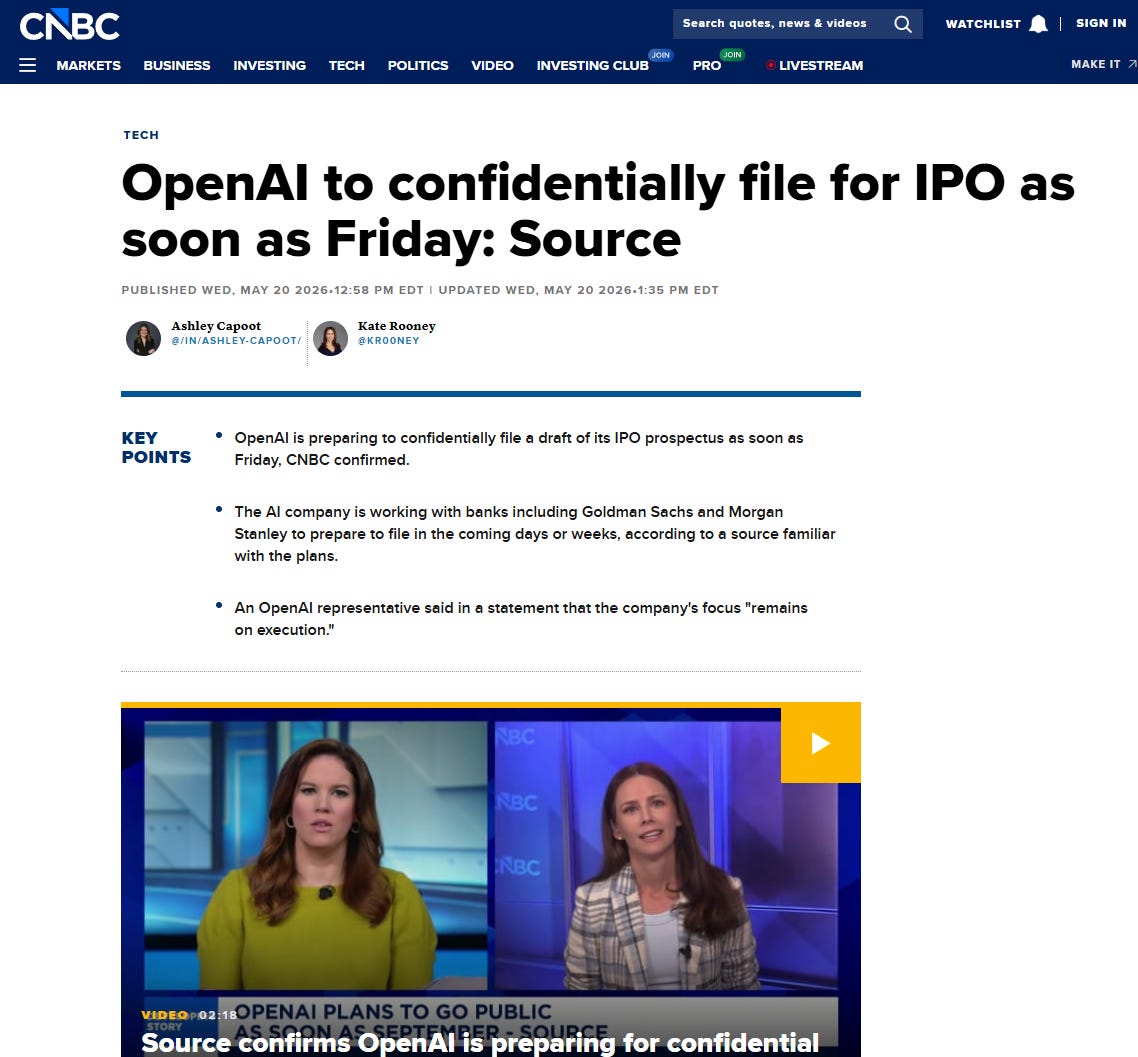
1. OpenAI files confidential IPO papers with the SEC today. The company you talk to is about to owe Wall Street a fiduciary duty.
OpenAI plans to file a confidential draft registration statement with the SEC as soon as today, Friday, May 22, 2026, multiple outlets reported this week. Goldman Sachs and Morgan Stanley are leading the deal; JPMorgan Chase is also involved. The most recent private round closed March 31 at a $852 billion post-money valuation, with Amazon, NVIDIA, and SoftBank participating. The targeted listing window is between Labor Day and Thanksgiving 2026. A confidential filing means the SEC review starts now, but the financials stay private; the public S-1 typically lands 60 to 90 days later, putting the first public look at OpenAI’s books in late July or early August.
The timing is not accidental. A federal jury rejected Elon Musk’s lawsuit against OpenAI in under two hours on May 18, removing the single largest legal overhang on the company’s corporate-governance story heading into public markets.
The day before the filing was reported, OpenAI president Greg Brockman consolidated ChatGPT, Codex, and the API under one head. The IPO is the milestone every restructuring decision over the last year has been building toward. The day the bell rings, OpenAI gains a new constituency: public shareholders, and with them, a legal duty to maximize their return. The product that has spent three years optimizing for “useful and safe” starts optimizing for “useful, safe, and reportable.” Those are not always the same thing.
Why this matters: If you use ChatGPT for work, for school, for personal things you do not type into Google, the company holding those conversations is about to become legally obligated to put shareholder returns ahead of every other priority. The free tier, the data-retention defaults, the model that answers when you do not specify, and the price of the paid tier will all start moving toward what the quarterly earnings call needs them to do.
Action this week: Open chat.openai.com, click your name in the lower left, go to Settings, then Data Controls, and turn off “Improve the model for everyone” before the IPO discipline locks in the data practices. If you run IT or are the BA who picked ChatGPT Enterprise for your shop, pull up your contract’s data-residency and termination clauses and put a calendar reminder for August 1 to re-read them once the public S-1 drops.
cnbc.com: OpenAI to confidentially file for IPO as soon as Friday
2. SpaceX’s IPO papers exposed Anthropic’s $40 billion compute deal. The 90-day exit clause means it can vanish in three months.
Continuing from 5.09 (Colossus 1 Anthropic announcement) with the financial terms now public.
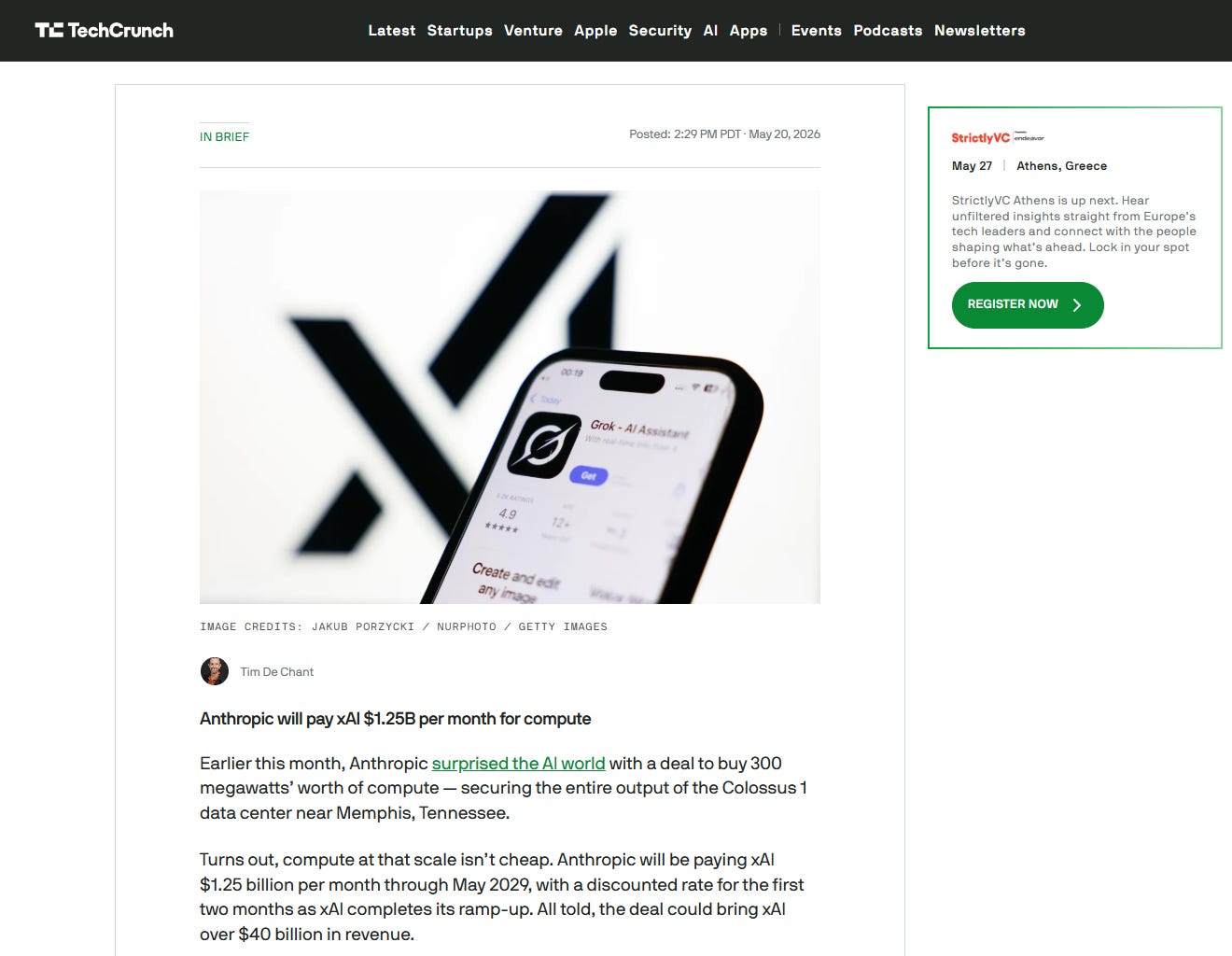
SpaceX filed an S-1 IPO registration statement this week, and buried inside the prospectus was the financial structure of a deal Anthropic announced on May 6: Anthropic will pay xAI $1.25 billion per month through May 2029, in exchange for all of the compute capacity at the Colossus 1 data center outside Memphis, Tennessee. Total contract value is more than $40 billion. The capacity Anthropic gets is 300 megawatts and roughly 220,000 NVIDIA GPUs. The first two months are at a discounted rate. The most-cited number in the filing was the monthly fee, but the most important number was lower in the disclosure: either Anthropic or xAI can terminate the contract with 90 days’ written notice.
A $40 billion contract that either side can walk away from in 90 days is not a four-year commitment; it is a rolling three-month lease that gets called a four-year commitment in the press release.
For Anthropic, it means the compute spine of the lab, whose pitch is “the safety alternative to OpenAI,” is rented from Elon Musk, whose own lab (xAI) is the explicit philosophical opposite of Anthropic’s safety frame. For Musk, it means the contract that just stabilized xAI’s balance sheet, which lost about $2.5 billion in the March quarter, has its lifeline written in 90-day increments.
Neither side has the leverage the headline number suggests. The deal that looked like a structural pivot in May is closer to a quarterly capacity rental priced at a billion-plus dollars per month.
Why this matters: If you picked Claude for work because you were told Anthropic was the safety-first lab, the SpaceX IPO papers just told you that every Claude conversation you send is running on compute rented from Elon Musk’s company at $1.25 billion a month, and the contract holding that arrangement together can be canceled by either side in 90 days. The safety-versus-chaos framing the AI industry sells you is sharing a power outlet, and the lease is month-to-month.
Action this week: Go to anthropic.com/legal and search the page for “subprocessor” and “compute provider”; if the SpaceX or xAI relationship is not disclosed there yet, that is the gap your compliance team needs to flag before the next vendor review. If you are an architect picking between Claude and ChatGPT for a 2027 commitment, add “what happens to your service if the underlying compute contract is terminated on 90 days’ notice” as a question for the next sales call.
techcrunch.com: Anthropic will pay xAI $1.25 billion per month for compute
3. Trump pulled the AI executive order hours before signing it. Federal pre-release review of frontier models just got punted.
Continuing 5.11 #1 and 5.16 #3 (federal AI oversight).
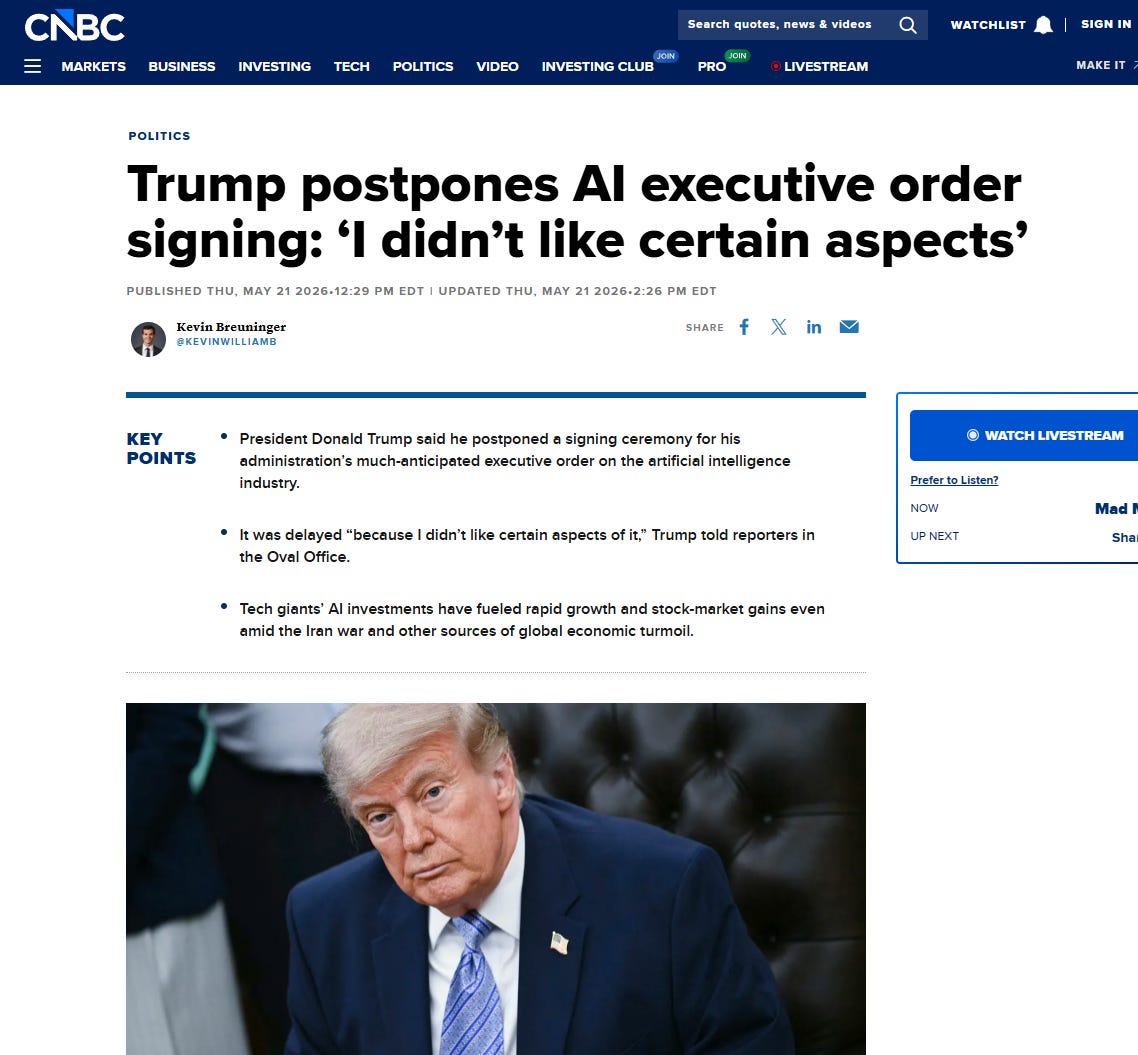
The White House postponed the planned signing of an artificial-intelligence executive order on Thursday, May 21, hours before President Donald Trump was scheduled to put pen to paper. Trump, asked by reporters why the signing was off, said: “I didn’t like certain aspects” of the order, and added that he did not want to do anything to slow the US lead over China on AI. The draft order, as reported by CNN, Axios, Washington Post, and CNBC, was split into two sections: a cybersecurity title and a second titled “covered frontier models” that defined which models would be eligible for voluntary federal pre-release review. The framework would have given federal agencies, including the National Security Agency, up to 90 days to inspect a new frontier model before the public could use it for classified testing.
Both OpenAI and Anthropic had been negotiating with the administration on the language. The voluntary framing is the load-bearing word: nothing in the draft would have forced a lab to share a model, and nothing would have stopped a lab that did from shipping anyway after the 90 days expired.
The order was already the lightest possible touch the federal government could put down in writing. The fact that even this version got pulled the morning of, after months of drafting, tells you the White House is no longer willing to set a precedent that federal review of AI happens before release. The fight over whether labs can ship without anyone outside the lab seeing the model is over for now, and the labs won by default.
Why this matters: If you wondered whether the federal government would test new AI models before they get into the phone in your pocket, the bank app your paycheck deposits into, or the chatbot that talks to your kid for homework, that pre-release review just got canceled. The next big model from OpenAI or Anthropic will ship the way every model has shipped so far: lab decides, lab releases, the public finds the dangerous edges by running into them.
Action this week: Bookmark whitehouse.gov/presidential-actions and federalregister.gov, then check both on Tuesday morning to see whether a revised AI executive order was filed over the weekend. If you advise on AI procurement at work, write down what you actually need to know about a model before you let your team use it (training-data sourcing, output-logging defaults, model-version pinning), because the answer to “did the federal government check this” is now “no.”
cnbc.com: Trump postpones AI executive order signing: ‘I didn’t like certain aspects’
4. Minneapolis paused new data centers on Thursday. The downtown core, where developers were already lining up, stayed open.
Continuing 5.21 #3 and 5.20 #3 (data-center community pushback).
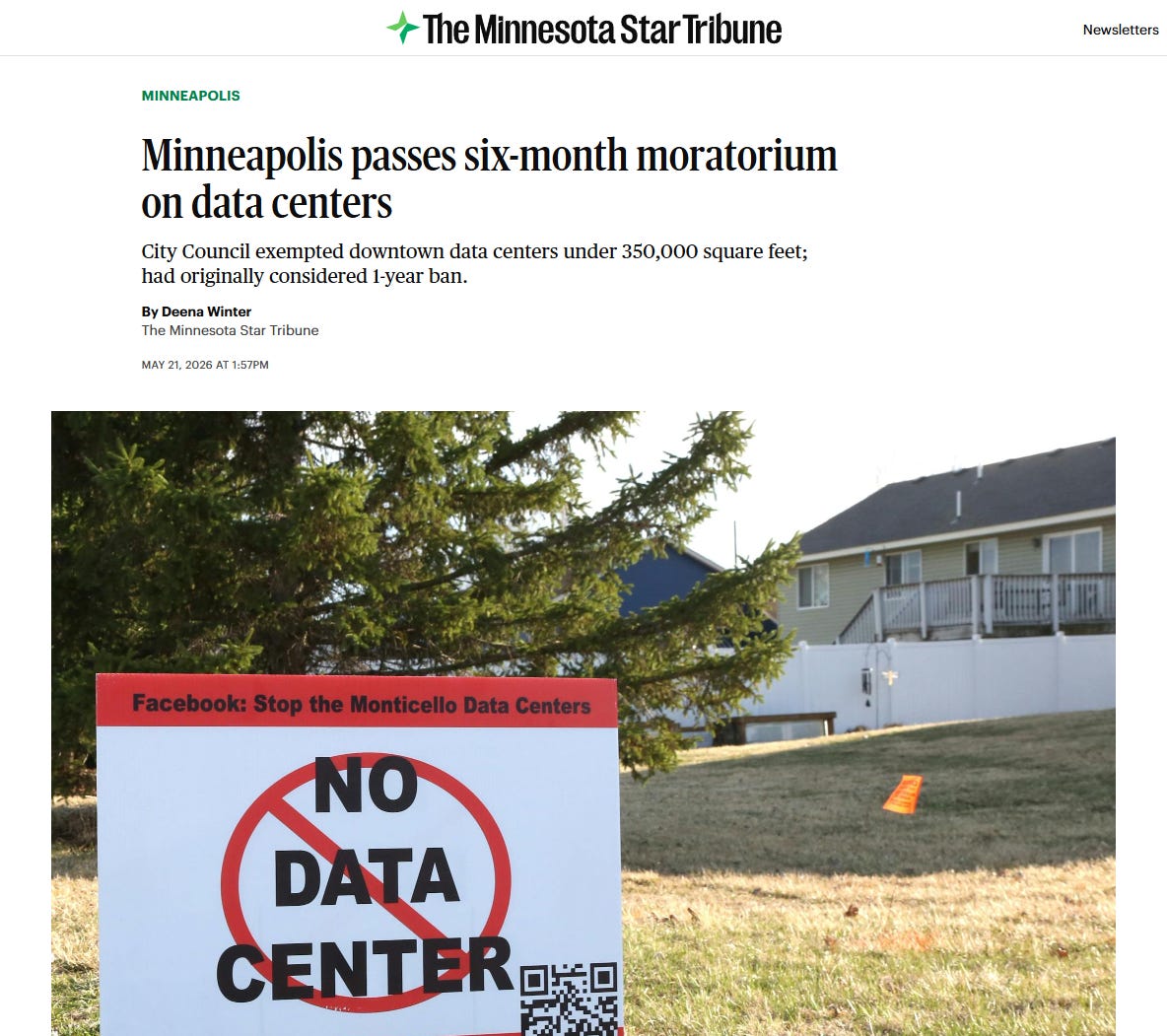
The Minneapolis City Council voted 8 to 5 Thursday for a six-month moratorium on new data centers, becoming the latest large US city to do so in a string that already included Denver (unanimous, one year, Monday), Cave City, Kentucky (4-1, twelve months, Wednesday), and Reno. The original Minneapolis proposal called for a 12-month pause. Council Member Aurin Chowdhury introduced the moratorium; an amendment from Council Member Osman cut it to six months as what supporters called a “middle ground.” The pause runs through November 21, 2026, and applies to data centers larger than 350,000 square feet.
The compromise that got the eighth vote is where the rule actually bites. Projects under 350,000 square feet inside the downtown core (bounded by Interstate 35W, Interstate 94, Plymouth Avenue, and the Mississippi River) are exempt. Downtown is also exactly where the developers, watching residential demand fall and commercial vacancy rates climb, had already been quietly converting building plans into data-center proposals.
The moratorium will stop a Saline-Township-scale 350-acre hyperscale facility on the city’s edge. It will not stop a 100,000-square-foot box on the third floor of a downtown high-rise.
During the pause, the council will study zoning, environmental impact, permitting, and the grid load the city’s utility can absorb. The shape of the rule that comes out in November is what determines whether the pause was a delay or a redirection.
Why this matters: If you live in or work in downtown Minneapolis, the rule the city council just passed paused the data centers your neighbors on the edges did not want, but kept the door open for new ones inside your skyline. The next blocky brick high-rise that flips from office to “tenant improvement” is the one to watch. If you live in a city that is about to have this same fight, the Minneapolis split (size threshold + neighborhood carve-out) is the compromise to expect when developers and the residents who do not want the noise meet in the council chamber.
Action this week: Go to lims.minneapolismn.gov and search “data center” to read the amended ordinance text and how each council member voted. If your own town is in this same fight, search your city council site for “moratorium” and “data center” to see whether a hearing is on the calendar and how comments are being accepted.
startribune.com: Minneapolis council approves 6-month moratorium on data centers, downtown exempt
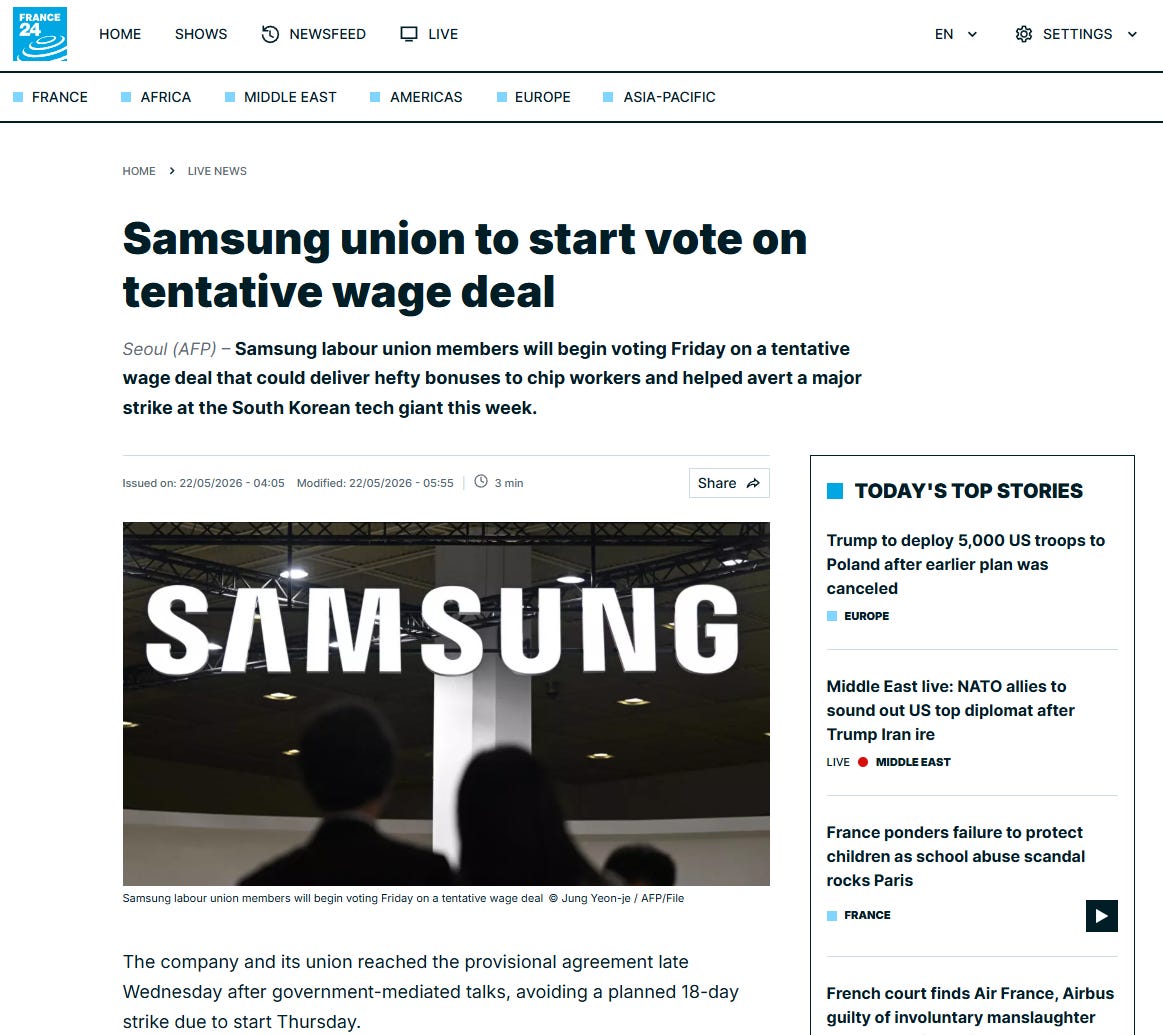
5. Forty-eight thousand Samsung chip workers start voting today on a deal that pays them $340,000 each from the AI bonus pool.
Continuing 5.21 #4 (Samsung tentative agreement). The vote opens today.
The National Samsung Electronics Union, which represents about 48,000 active workers at Samsung Electronics, opened a ratification vote at 2:00 PM Korea time today, Friday, May 22, on the tentative agreement that called off an 18-day strike on Wednesday. Voting runs through 10:00 AM Wednesday, May 27, with roughly 70,000 members eligible (active plus union-eligible non-active). The deal auto-ratifies if more than half the eligible members cast ballots and a majority of those voting approve. The union leader has publicly predicted ratification.
The numbers under the deal are the largest in the year's semiconductor labor settlements.
Samsung will direct 10.5 percent of its operating profit into stock bonuses plus a separate 1.5 percent in cash, and will delay by one year a new bonus-distribution method that would have spread chip-division payouts across loss-making consumer-electronics units. Samsung’s chip division is projected to distribute about 40 trillion won, or $26.6 billion, in bonuses this year, with the average individual payout of about 513 million won, or $340,000.
The economic logic is straightforward: Samsung leads the global DRAM market, sits second behind SK Hynix in the high-bandwidth memory that AI training depends on, and the workers making those chips just used the bonus formula to convert the AI training boom directly into their paychecks. Some Samsung shareholder groups have announced legal challenges to the deal.
Why this matters: If you work somewhere your company has been telling you AI is going to make the business more profitable and that profit needs to go to shareholders first, the 48,000 chip workers in Korea just gave you a template for a different answer. They tied their bonus pool directly to the line item AI is moving on the income statement, and they did it by threatening to walk off the line where the chips that train every model in this newsletter get made.
Action this week: Search your own most recent earnings call transcript for the word “AI” and see whether any of the productivity gains being described are showing up in the part of the call that talks about employee compensation. If you are in a union (or on the bargaining committee for one), pull the NSEU framework (10.5 percent of operating profit, one-year delay on cross-division redistribution) as a template for your next contract negotiation, and forward this section to whoever handles communications for your local.
france24.com: Samsung union to start vote on tentative wage deal
» What to watch this week
OpenAI confidential S-1 confirmation. The CNBC and Axios sources reporting “as soon as Friday” are anonymous; if the filing actually lands, expect Goldman Sachs and Morgan Stanley to confirm via press release within 24 hours, and the SEC’s EDGAR system will not show anything (confidential filings stay private until the public S-1 lands 60 to 90 days later).
Samsung NSEU ratification. Vote closes 10 AM Korea time, Wednesday, May 27. Watch turnout: the deal requires more than 50 percent of about 70,000 eligible members to cast ballots before a majority-of-voters threshold applies. Shareholder legal challenges have already been announced.
Revised AI executive order draft. Trump said only that the order was “postponed,” not killed. Watch federalregister.gov and whitehouse.gov/presidential-actions on Monday and Tuesday for a re-drafted text. Whether NSA-classified testing and the 90-day window survive the redraft is the editorial signal.
Minneapolis ordinance text. The amended six-month moratorium text and the council vote breakdown are at lims.minneapolismn.gov. The detail to watch: whether the downtown-core exemption applies to all data centers under 350,000 square feet, or whether the building’s primary use must be something else. That language difference determines whether the moratorium has teeth.
SpaceX S-1 follow-on details. The Anthropic-xAI contract is one disclosure; the prospectus also discloses Starlink ARR, the Falcon launch backlog, and SpaceX’s own AI compute spend. Expect investment bank breakdowns over the weekend that pull out the second and third numbers the press missed on Tuesday.
Tomorrow’s signal lands here.
PickBits Daily Signal is a working brief by Mark Pickering. If a friend forwarded this to you, you can subscribe at pickbitsai.substack.com; it is free.