
89,000 chip workers are voting right now on a $26 billion AI-profit bonus. Their shareholders just sued to stop it.
PickBits Daily Signal · Saturday, May 23, 2026

// tl;dr
Samsung chip workers hit a 74 percent turnout on Day 1 of their six-day ratification vote, with 89,000 union members deciding on a deal averaging $400,000 per memory-division worker. Samsung shareholders declared the deal illegal and filed to block it. Samsung mobile workers, who receive $4,000 under the same deal, filed a separate court injunction. The vote closes May 27.
Anthropic is closing a $30 billion-plus round as soon as next week at a valuation above $900 billion, Bloomberg reported Thursday. Q2 revenue is projected at $10.9 billion, up 130 percent from Q1’s $4.8 billion. The company is on pace for its first profitable quarter. Sequoia Capital, Dragoneer, and Altimeter lead the round.
Cloudflare cut 1,100 workers, 20 percent of its staff, while posting record Q1 revenue, and CEO Matthew Prince publicly named the category AI eliminated: he called them measurers. Middle managers, finance teams, auditors, compliance, and revenue recognition. “AI isn’t coming for builders or sellers,” he said. “But it is coming for measurers.”
California’s Senate passed two AI worker bills: SB 947 gives workers the right to know when automated systems make decisions about their jobs, and SB 951 requires employers to disclose AI as a cause in mass layoffs. Both go to Governor Newsom. No signing date announced.
Who is responsible when AI goes wrong? Monday, the executive order got pulled. Tuesday, the compute contract nobody was supposed to see ended up in SpaceX’s IPO filing. By Thursday, the question had turned. Eighty-nine thousand Samsung chip workers began voting on whether the people making the hardware that runs every large language model you have ever used would collect a share of the revenue that hardware generates. Their shareholders and their colleagues in the mobile division both went to court to say no. That is not a story about AI going wrong. That is a story about AI going so right that the fight is now over the money. At the same time, the company that positioned itself as the safety-first alternative to the chaos lab is about to close the largest private funding round in the history of artificial intelligence, at a valuation approaching a trillion dollars. And California’s legislature, having watched Washington defer and delay, passed two bills that would let workers find out whether an AI system had a say in firing them.
Today’s news is not about AI failing. It is about AI succeeding so thoroughly that the question of who gets paid for it has reached the courts, the legislature, and the ballot box simultaneously.
1. Samsung chip workers voted 74 percent in a single day. Their shareholders and colleagues in mobile both filed to stop the payout.
Continuing 5.22 #5 (Samsung NSEU ratification vote opens). Day 1 data now in.
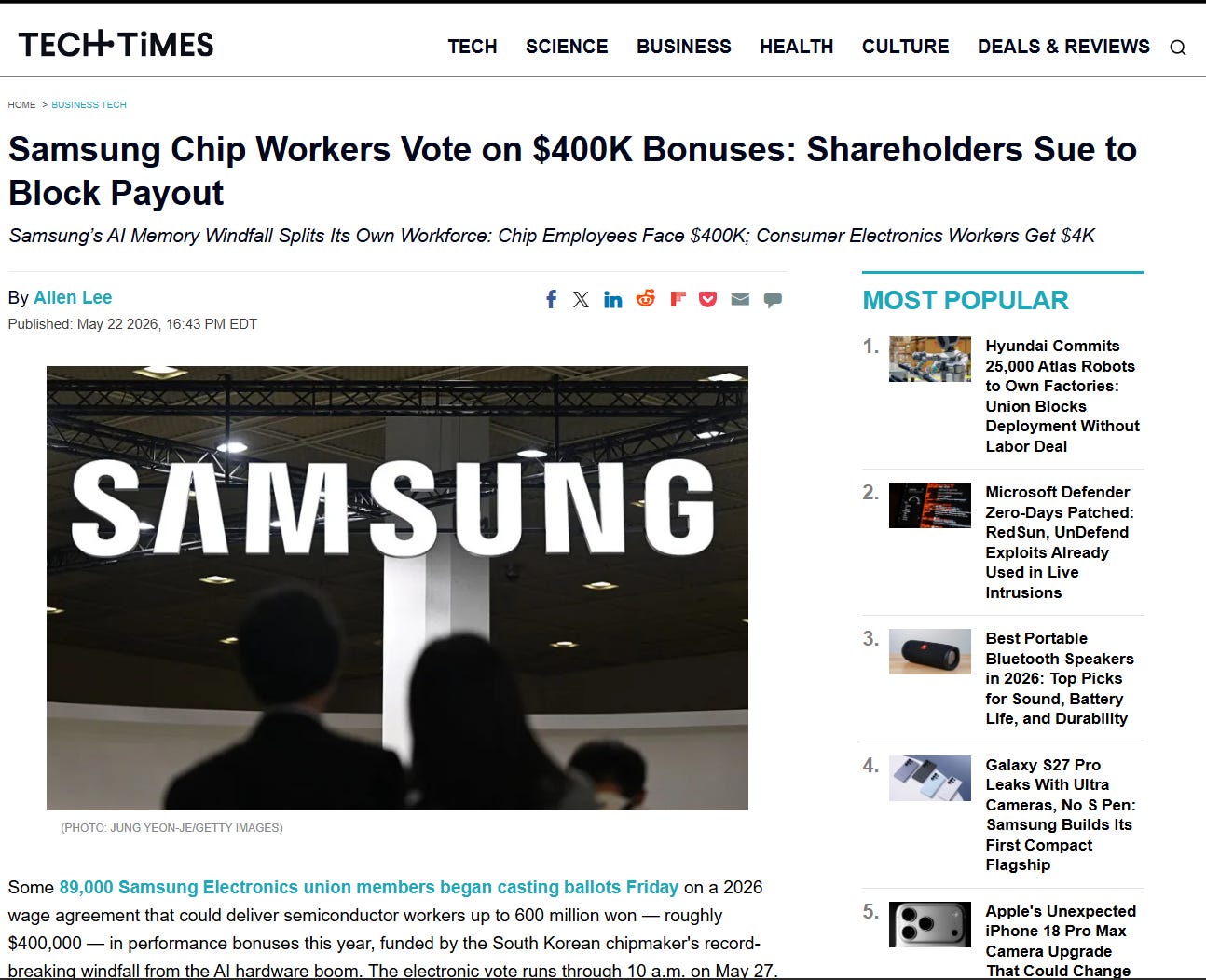
The National Samsung Electronics Union opened its ratification vote on Thursday at 2 PM Korea time. By the end of Day 1, more than 74 percent of the roughly 89,000 eligible members had cast ballots, according to the Seoul Economic Daily. That pace points toward near-certain ratification: the deal requires more than 50 percent participation before a majority-of-voters threshold applies, and Day 1 alone likely cleared it. The union leader publicly predicted a yes vote before the window even opened.
The deal under the vote: Samsung Electronics will direct 10.5 percent of its semiconductor division’s business-performance profits to workers as stock bonuses, plus a 1.5 percent cash component, and will delay by one year a plan to spread chip-division bonuses across the loss-making mobile and home-appliance units.
Total projected payout from the semiconductor division: roughly 40 trillion won, or $26.6 billion. The average worker in the memory and chip-fabrication units would receive about 600 million won, roughly $400,000. The deal averted an 18-day strike analysts estimated would cost $11.7 billion in lost production.
Two separate legal challenges materialized within hours of the vote opening. A group of Samsung shareholders declared the deal “illegal” and filed to block it unless it was put to a general shareholder vote. Separately, workers in Samsung’s mobile and home-appliance divisions, who receive an average of about $4,000 under the same deal, filed a court injunction seeking to stop ratification or force a renegotiation. The Korean Labor Ministry sided with the memory union, improving the odds that the deal survives a challenge. But the two-front resistance makes this as much a story about how AI revenue gets distributed as it is about labor relations.
Why this matters: Samsung’s semiconductor division made 94 percent of the company’s Q1 profits on the back of AI-training demand for high-bandwidth memory. The workers who built those chips are voting right now on whether a share of those profits routes to them, while their shareholders argue the money belongs to the investors, and their colleagues in mobile argue the formula is unfair. If you work in tech or manufacturing and your company has been reporting AI-driven productivity gains while your compensation stays flat, the NSEU framework is the template: tie your bonus pool directly to the line item for AI on the income statement, not to a flat raise the company controls.
Action this week: Search your company’s most recent earnings call transcript for the word “AI productivity” and check whether any of that language appears in the compensation section. If it does not, that is the gap to name in your next review.
en.sedaily.com: Samsung wage deal vote tops 74 percent on Day 1 · techtimes.com: Samsung chip workers vote on $400K bonuses as shareholders sue to block payout
2. Anthropic is closing a $30 billion-plus round next week at a valuation above $900 billion. It is on pace for its first profitable quarter.
Bloomberg reported Thursday that Anthropic’s latest funding round is expected to close as soon as next week at a post-money valuation above $900 billion, making it the most valuable private AI company on Earth and passing OpenAI’s most recent $852 billion post-money figure. The round will total more than $30 billion and is co-led by Sequoia Capital, Dragoneer, and Altimeter Capital.
The financial picture behind the number: Anthropic’s annualized revenue crossed $30 billion in April. Q2 2026 revenue is projected at $10.9 billion, more than doubling Q1’s $4.8 billion. The company is on pace for its first profitable quarter. Four years ago, it was a research spinout of safety-focused researchers who left OpenAI over disagreements about the pace of deployment. Today, the company that has made responsible AI its pitch is approaching Saudi Aramco's valuation.
One deployment of that scale worth noting separately: this month, Anthropic committed to a $200 million partnership with the Gates Foundation, combining grant funding, Claude usage credits, and technical support for programs in global health, life sciences, education, and economic mobility over four years. At $900 billion in paper value, it is 0.02 percent of the company’s valuation.
Why this matters: The valuation ladder for AI labs has moved faster than any technology category in recorded history. At $900 billion, Anthropic is not a startup. It is the fifth-most-valuable US technology company, one that did not exist six years ago. When the lab whose entire pitch is “we are the careful one” reaches a valuation this large, the pressure to maintain that pitch against quarterly revenue expectations is substantial. Every product decision, every pricing change, and every safety tradeoff from here is effectively a public-markets decision, even before the IPO.
Action this week: If you are evaluating Claude for a 2027 contract, ask your Anthropic sales rep explicitly which commitments regarding model version pinning, data handling, and service continuity will survive a change in ownership or a public listing. Put that answer in writing before you sign.
bloomberg.com: Anthropic to close over $30 billion round as soon as next week · business-standard.com: Anthropic set to close over $30 billion round
3. Cloudflare’s CEO just named the job category AI killed. He called them measurers.
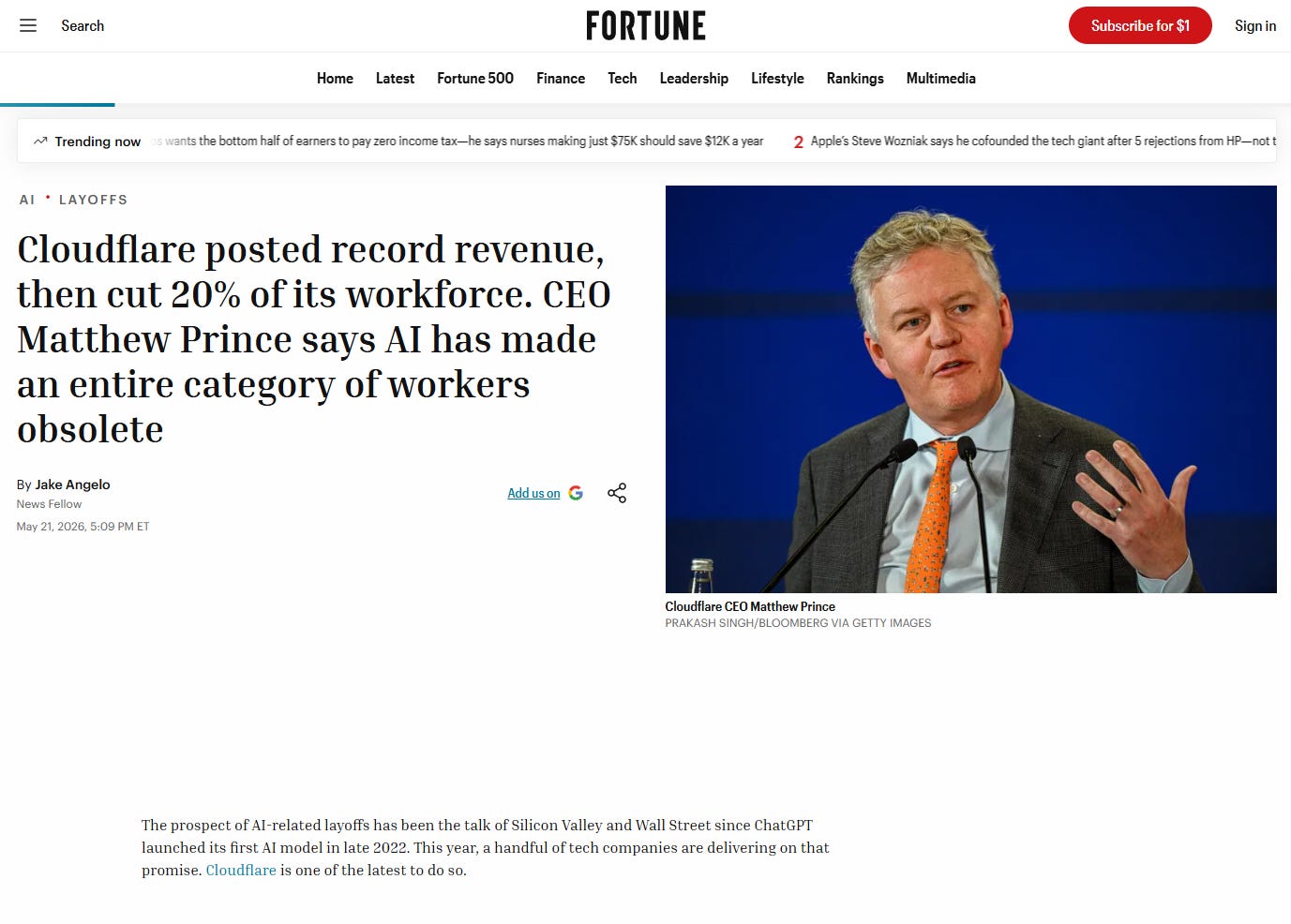
Cloudflare cut 1,100 workers, roughly 20 percent of its 5,156-person workforce, this month while posting record Q1 revenue. CEO Matthew Prince, writing in Fortune on May 21, did not use the word “restructuring.” He gave the category a name.
The people AI had replaced, he wrote, were the measurers: middle managers, internal finance and audit teams, compliance staff, revenue recognition analysts, and anyone whose job was fundamentally to count and verify the work of others. “AI isn’t coming for the builders,” he wrote. “It’s not coming for the sellers. But it is coming for the measurers.”
Cloudflare’s AI usage grew 600 percent in the three months before the announcement. The company’s argument is that AI handles measurement tasks so thoroughly that the headcount previously dedicated to them is now redundant at record revenue levels. That argument is unusual because it comes with a named category, a specific mechanism, and a CEO willing to say it publicly while the Q1 earnings report is still fresh.
A separate Fortune analysis of demand signals across 55,000 job skills found that aggregate job demand has not collapsed across AI-adopting industries, but that task-level displacement is landing on specific roles much faster than headline job-count figures suggest. The Cloudflare cut is notable precisely because it names the mechanism rather than citing budget pressure or market conditions.
Why this matters: If your job title contains “analyst,” “auditor,” “coordinator,” “compliance,” “revenue operations,” or “manager” at a company that has started its AI investment cycle, a $30 billion company’s CEO just publicly described your category as the one AI replaces first. This is not a prediction about a future model. Cloudflare already did it, at record revenue, and named the role. The question for everyone in those positions is whether your organization is six months behind Cloudflare or two years.
Action this week: Open your job description and map each bullet point to either “builds something,” “sells something,” or “measures something.” If more than half your responsibilities are measurement tasks, you are in the category Prince named. That is not a reason to panic. It is a reason to start a conversation with your manager about which of your functions could be automated and which require human judgment that the tool cannot replicate, before someone else has that conversation about you.
fortune.com: Cloudflare CEO Matthew Prince on who AI is actually replacing · cnbc.com: Cloudflare Q1 earnings (record revenue)
4. California’s Senate passed two AI worker bills last week. Now they go to Newsom.
On May 19, the California Senate passed SB 947, which would require any employer that uses automated employment-decision technology for hiring, firing, scheduling, or performance evaluation to disclose that use to affected workers and provide a pathway to human review. On May 20, the Senate passed SB 951, a digital displacement notice bill that would amend California’s WARN Act to require employers to identify AI as a contributing cause when it is a material factor in a mass layoff. Both bills passed with bipartisan support. Both go to Governor Gavin Newsom. No signing date has been announced.
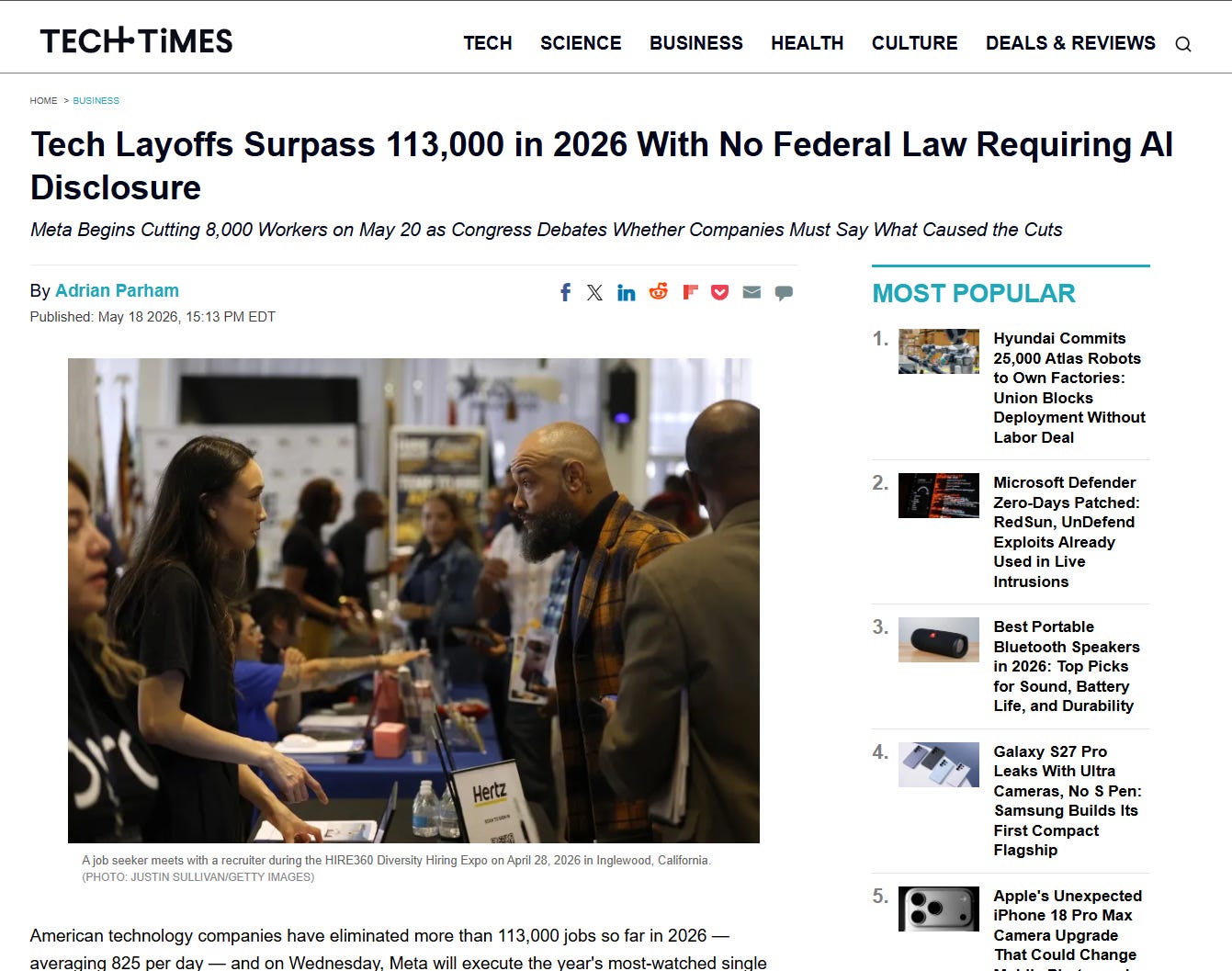
The federal context: the PREPARE Act (S.3339), which would create a national AI-cause disclosure requirement for mass layoffs, has stalled in the Senate. More than 113,000 tech workers have been laid off in 2026 year-to-date, and under current federal law, companies can publicly attribute cuts to AI with no legal obligation to verify that claim. California accounts for roughly 14 percent of US GDP and is home to most major tech employers. When California passes a worker protection law, employers operating nationwide typically must decide whether to comply nationally or maintain two separate systems.
Why this matters: If you have been told your position was eliminated due to “business restructuring” or “operational efficiency” at a California employer, and you suspected AI, SB 951 would give you the legal right to that answer on your WARN Act notice. If you sit on an HR or legal team at a California company that uses AI for resume screening, performance scoring, or scheduling, SB 947 would require you to disclose that use to every affected employee and offer a human-review option. Both bills still need a governor’s signature. But California worker protections routinely become the national baseline.
Action this week: Search your employee handbook and your company’s published AI policy for the words “automated decision” and “employment decision.” If neither term appears, your HR department has not yet written a disclosure policy. The moment to get ahead of this is before Newsom signs, not after.
leginfo.ca.gov: SB 947 status · leginfo.ca.gov: SB 951 status · techtime
s.com: Tech layoffs surpass 113,000 in 2026 with no federal disclosure law
5. Five hundred New York small businesses gave Governor Hochul 12 days to act on AI data centers. The session ends June 4.
On May 21, nearly 500 New York small businesses signed a letter to Governor Kathy Hochul and the state legislature demanding passage of S9144 / A10141, a bill that would impose a three-year moratorium on new data centers larger than 20 megawatts in New York State while the Department of Environmental Conservation studies impacts and the Public Service Commission develops ratepayer protections. The New York legislative session ends June 4, leaving roughly 12 working days. On May 22, residents of East Fishkill in the Hudson Valley held a public rally opposing a proposed hyperscale data center in their community and presented a petition with more than 1,000 signatures to local officials.
The small business coalition’s argument is not about aesthetics or community character. It is about the electric grid. Large AI data centers draw enormous amounts of power, and when utilities upgrade transmission infrastructure to serve them, the cost is typically spread across all ratepayers on the grid, including the small businesses that did not request the upgrade and will not directly benefit.
The coalition’s letter argues that any new data center above the 20-megawatt threshold should be required to fund its own grid interconnection rather than socializing those costs.
The 500 businesses signing represent roughly 98 percent of all New York businesses by category, according to Food and Water Watch, which organized the letter.
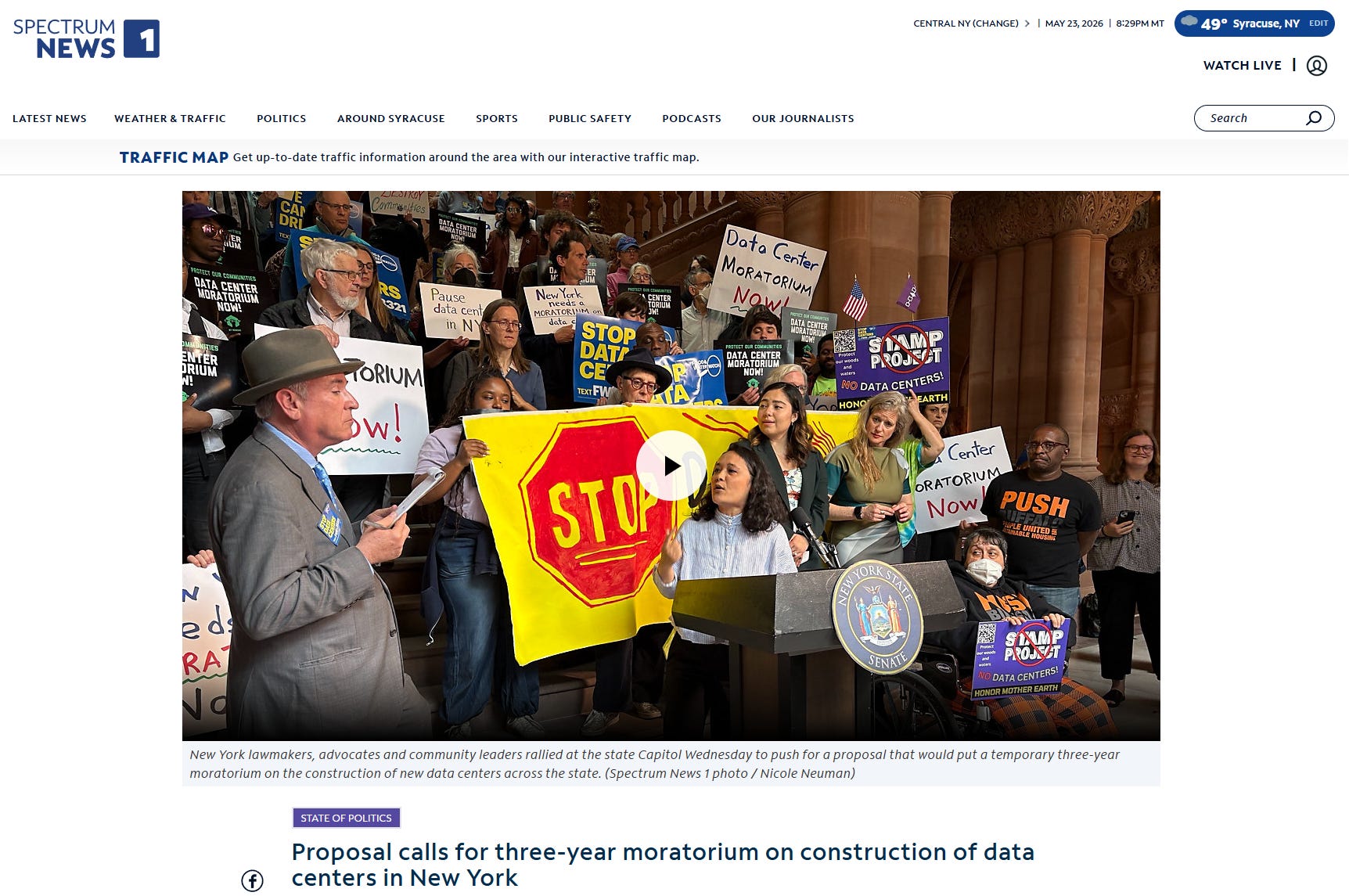
Why this matters: If you run a small business in New York, 500 of your counterparts just put the case in direct terms: AI data centers benefit the companies that own them, but the grid upgrades they require show up on everyone else’s electric bill. That is not a community-character argument. It is a cost-shifting argument, and it now has a small-business constituency behind it that differs from the residential coalitions that have been driving municipal moratorium votes over the past two months.
Action this week: Search your state legislature’s bill-tracking site for “data center moratorium” or “data center ratepayer” to see whether your state has a similar bill in committee. If your state session is ending soon, the contact page for your state representative is typically at [state].gov/legislature.
foodandwaterwatch.org: Hudson Valley residents rally against massive data center proposal in East Fishkill · spectrumlocalnews.com: Lawmakers push for data center moratorium this session
» What to watch this week
Samsung NSEU vote closes Wednesday, May 27, 10 AM Korea time. The NSEU will announce the result on the same day. Watch for whether the shareholder or mobile-worker court injunction is granted before the window closes, which would suspend the count. If ratified, the next milestone is the Korea Labor Ministry approval timeline and whether legal challenges proceed to a hearing date.
Anthropic funding round closed. Bloomberg reported this “as soon as next week.” A press release or equivalent filing will confirm the valuation. Watch for whether the announcement also includes a statement on compute infrastructure, given the scrutiny of the xAI-Colossus deal disclosed in last week’s SpaceX S-1.
Governor Newsom and SB 947 plus SB 951. Neither bill has a signing date. California employers have lobbied against both. Watch for a governor’s office statement on AI worker legislation before the end of May.
New York data center moratorium bill S9144. The session ends June 4. Watch for a committee vote or floor vote in the next 12 working days. The 500-business coalition letter puts small-business opposition to the status quo on the record for the first time in this legislative cycle.
Trump revised the AI executive order. Postponed May 21, not killed. Watch federalregister.gov and whitehouse.gov/presidential-actions on Monday for a re-drafted text. Whether the NSA pre-release testing role survives the revision is the editorial signal.
Tomorrow’s signal lands here.
PickBits Daily Signal is a working brief by Mark Pickering. If a friend forwarded this to you, you can subscribe at pickbitsai.substack.com; it is free.